I didn't post last week. I was and remain so troubled by social and political conditions in the US that I am still organizing my thoughts. I have also started a new ship model and have written three new piano pieces, so my mind has, literally, been elsewhere. The topic of the week, however, is the new uprising in Iraq.
This has made for much 'news' (read: misinformation) and much assigning of blame for the current situation. Bush ahs been blamed by Democrats for starting a war for no good reason, leaving Iraq unstable. Obama has been blamed for being so weak that Arab revolutionaries dared to attack their own government. I am reminded of a joke about the hard landing of a plane. It wasn't the pilot's fault and it wasn't the controller's fault. It was the asphalt. Neither Bush nor Obama are to blame here. There is instead a long and ugly history. The story, for practical purposes, starts during WW1. England and France were allied with Russia in fighting Germany, Austria and the Ottoman Empire.
Most people have no more recognition of the Ottoman Empire than they do of the Byzantine Empire. They wave their hands vaguely 'over there' and then say 'it fell'. The Ottoman Empire was formed in 1299 by Osman Bey. Ottoman is a transliteration as gross as Vienna is for Wien. A closer pronunciation would by Osmanian or Osmany Empire. Regardless, the OE was a major state until the mid-19th century. It gradually came undone in the face of nationalism, graft and modern communication and military problems. There is a long history of enmity between Russia and the OE, based both on religious grounds (Russia is the Protector of Orthodox states, and the OE had a large, oppressed Orthodox minority) and geographic (The OE controlled the Bosporus). Germany courted the OE, and that and the history with Russia led to the OE allied with Germany.
During the war Britain and France invaded and attacked the OE. The Gallipoli campaign, and campaigns in Palestine (Lawrence of Arabia), Egypt and Mesopotamia (modern Iraq) resulted. Britain had a marked interest in various parts of the OE, especially Mesopotamia, because of its oil reserves (ships converted to oil fuel during WW1, and England wanted to control an oil source). Britain made the famous Balfour declaration in 1917, to the effect that Jews ought to have a national homeland in Palestine. During 1916 there was a secret agreement between France and England to divide portions of the OE. The partition was called the Sykes-Picot line. This line is the basis of the borders of modern Syria, Jordan and Iraq.
All these lines and declarations were utterly arbitrary, based purely on the reputation and needs of the victors. They had nothing to do with the ethnic, religious and nationalist sentiments of the OE. This was in direct contradiction to Wilson's famous 14 Points, which were the basis of the Versailles Treaty (there were, admittedly, many violations of these points, not least the exclusion of Sudeten Germans from Germany, and the inclusion of German lands in the new Poland. WW2 anyone?). The result was an impressive divergence of the ethnic regions of the OE from the borders of the new countries carved from it. Here is a map superimposing the ethnic units and the political ones-
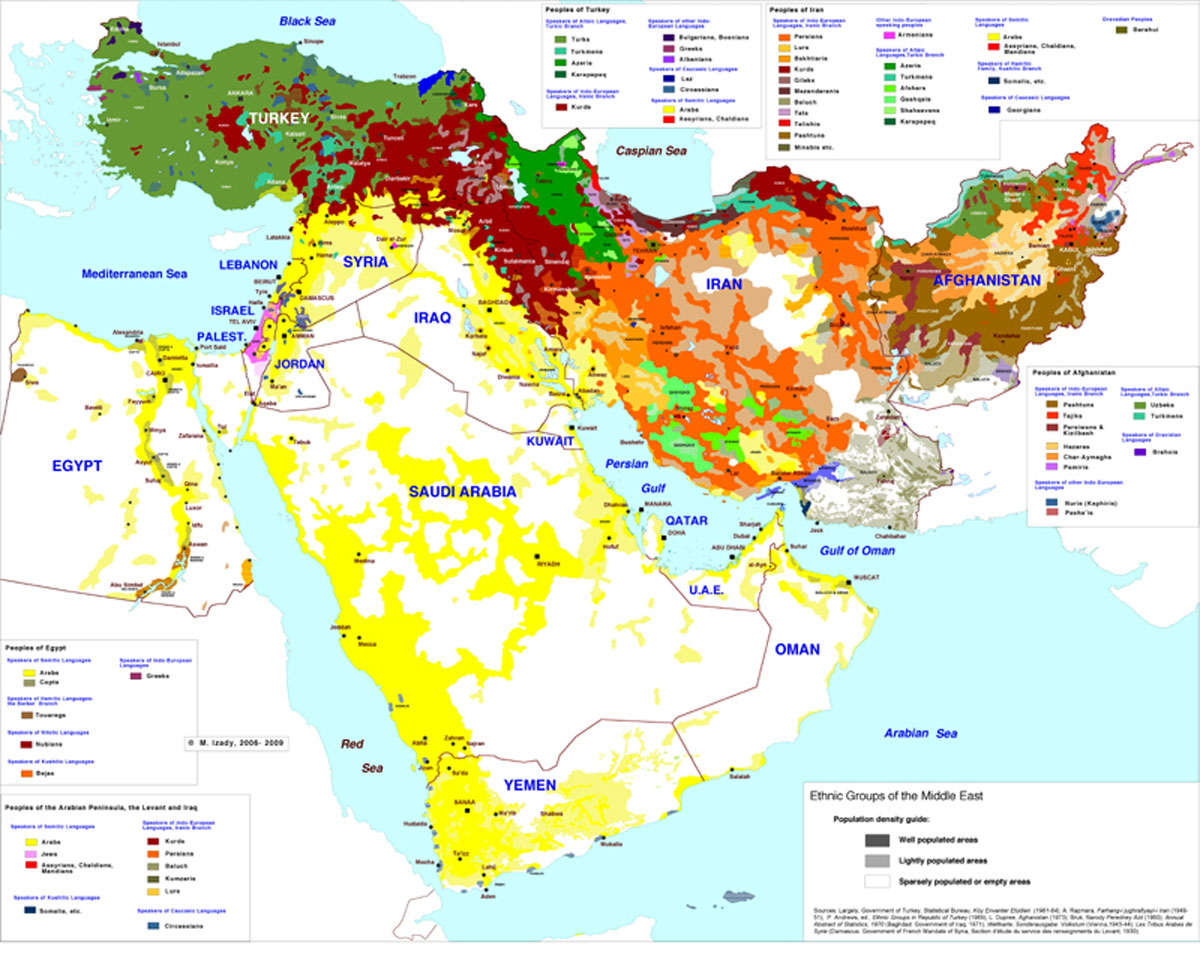
If you prefer to look at this in a link, it is here. Note the marked Kurdish area in dark red, that extends across the borders of Turkey and Iraq, and the concentration of Jews in Palestine. Of further note, Kuwait, long a part of Mesopotamia, was carved out as an independent state (in reality an oil client of England). The Kurds never got the Kurdistan they wanted, leading to separatist movements in Turkey and Iraq.
Not shown on this map are the religious divisions of the area. To Britain and France in 1919 all the inhabitants were simply Mohammedans. The differences between Shiite and Sunni were ignored, as stupid a mistake as mixing Catholic and Protestant. Iraq and Syria have been as religiously volatile as Northern Ireland as a result. here is a religious map of the same area-

Areas of religious separation cross political lines just like the ethnic one do. In many cases there is far greater ethnic and religious harmony within small groups than there is within the 'nations' created.
From 1920 onwards both US and British governments have been involved in manipulation of the governments of all the states carved out of the OE, as well as of the government of Iran. The motivating forces have been securing an oil supply and preventing spread of Russian influence in the region (until finding its huge gas reserves Russia coveted the oil of the area, and also wanted Iran for a port). Either the US, Britain or both has been involved in multiple 'regime changes' for Iraq, Iran and Palestine.
The Persian Gulf War inflamed separatist sentiments in Iraq, which the US failed to support. Saddam brutally repressed the uprisings. 12 years later in the Iraq War there was (and is) much resentment of US occupation and policy, leading to 'insurgencies' against the US backed central government. Much of the argument has been over three cities- Fallujah in the west and Mosul and Kirkuk in the north. These cities fall within the areas of ethno-religious differentiation on the above maps. The 'separatists' are, in their eyes, ethnic and religious freedom fighters.
And so here we are. The last 25 years have been one more messy episode in a series of such episodes over the 90 years. That it is the longest and messiest reflects not Bush's unnecessary machismo or Obama's lack thereof. I contend it is a result of a failure to understand conditions in the area, and most especially an unwillingness to be sufficiently ruthless in pursuit of our own goals.
For whatever else Britain's empire was, it was run efficiently and ruthlessly, just as was Rome's. If a country is going to assume control of another country's territory it must have complete control. Not the ruthless control of Nazi Germany, which actively alienated the places it wished to rule, but order. Worship any god you like, speak any language you like, but there WILL be order, and all official business is done in our language and our way.
Bush 1 did not press home his success, fearing to alienate his Arab allies. Bush 2 attacked with insufficient force to control Iraq. he confused military victory with pacification, ignoring professional advice to the contrary. It ultimately took every bit as much ground force to fully pacify Iraq as had been predicted. Obama has failed to articulate and enforce American will. If you don't want Arab national separatists to peck at Baghdad you have to leave/have/use enough force to enforce your desire.
As I see it, America has failed through an inadequate use of force secondary to a lack of will. I believe that ultimately the national boundaries in the middle east will more truly reflect ethno-religious ones. if the West wants peace, I think we would do well to encourage ethno-religious sorting and stop pretending the lines we drew 90 years ago are legitimate.
Ted, imperial anarchist (?)
This has made for much 'news' (read: misinformation) and much assigning of blame for the current situation. Bush ahs been blamed by Democrats for starting a war for no good reason, leaving Iraq unstable. Obama has been blamed for being so weak that Arab revolutionaries dared to attack their own government. I am reminded of a joke about the hard landing of a plane. It wasn't the pilot's fault and it wasn't the controller's fault. It was the asphalt. Neither Bush nor Obama are to blame here. There is instead a long and ugly history. The story, for practical purposes, starts during WW1. England and France were allied with Russia in fighting Germany, Austria and the Ottoman Empire.
Most people have no more recognition of the Ottoman Empire than they do of the Byzantine Empire. They wave their hands vaguely 'over there' and then say 'it fell'. The Ottoman Empire was formed in 1299 by Osman Bey. Ottoman is a transliteration as gross as Vienna is for Wien. A closer pronunciation would by Osmanian or Osmany Empire. Regardless, the OE was a major state until the mid-19th century. It gradually came undone in the face of nationalism, graft and modern communication and military problems. There is a long history of enmity between Russia and the OE, based both on religious grounds (Russia is the Protector of Orthodox states, and the OE had a large, oppressed Orthodox minority) and geographic (The OE controlled the Bosporus). Germany courted the OE, and that and the history with Russia led to the OE allied with Germany.
During the war Britain and France invaded and attacked the OE. The Gallipoli campaign, and campaigns in Palestine (Lawrence of Arabia), Egypt and Mesopotamia (modern Iraq) resulted. Britain had a marked interest in various parts of the OE, especially Mesopotamia, because of its oil reserves (ships converted to oil fuel during WW1, and England wanted to control an oil source). Britain made the famous Balfour declaration in 1917, to the effect that Jews ought to have a national homeland in Palestine. During 1916 there was a secret agreement between France and England to divide portions of the OE. The partition was called the Sykes-Picot line. This line is the basis of the borders of modern Syria, Jordan and Iraq.
All these lines and declarations were utterly arbitrary, based purely on the reputation and needs of the victors. They had nothing to do with the ethnic, religious and nationalist sentiments of the OE. This was in direct contradiction to Wilson's famous 14 Points, which were the basis of the Versailles Treaty (there were, admittedly, many violations of these points, not least the exclusion of Sudeten Germans from Germany, and the inclusion of German lands in the new Poland. WW2 anyone?). The result was an impressive divergence of the ethnic regions of the OE from the borders of the new countries carved from it. Here is a map superimposing the ethnic units and the political ones-
If you prefer to look at this in a link, it is here. Note the marked Kurdish area in dark red, that extends across the borders of Turkey and Iraq, and the concentration of Jews in Palestine. Of further note, Kuwait, long a part of Mesopotamia, was carved out as an independent state (in reality an oil client of England). The Kurds never got the Kurdistan they wanted, leading to separatist movements in Turkey and Iraq.
Not shown on this map are the religious divisions of the area. To Britain and France in 1919 all the inhabitants were simply Mohammedans. The differences between Shiite and Sunni were ignored, as stupid a mistake as mixing Catholic and Protestant. Iraq and Syria have been as religiously volatile as Northern Ireland as a result. here is a religious map of the same area-

Areas of religious separation cross political lines just like the ethnic one do. In many cases there is far greater ethnic and religious harmony within small groups than there is within the 'nations' created.
From 1920 onwards both US and British governments have been involved in manipulation of the governments of all the states carved out of the OE, as well as of the government of Iran. The motivating forces have been securing an oil supply and preventing spread of Russian influence in the region (until finding its huge gas reserves Russia coveted the oil of the area, and also wanted Iran for a port). Either the US, Britain or both has been involved in multiple 'regime changes' for Iraq, Iran and Palestine.
The Persian Gulf War inflamed separatist sentiments in Iraq, which the US failed to support. Saddam brutally repressed the uprisings. 12 years later in the Iraq War there was (and is) much resentment of US occupation and policy, leading to 'insurgencies' against the US backed central government. Much of the argument has been over three cities- Fallujah in the west and Mosul and Kirkuk in the north. These cities fall within the areas of ethno-religious differentiation on the above maps. The 'separatists' are, in their eyes, ethnic and religious freedom fighters.
And so here we are. The last 25 years have been one more messy episode in a series of such episodes over the 90 years. That it is the longest and messiest reflects not Bush's unnecessary machismo or Obama's lack thereof. I contend it is a result of a failure to understand conditions in the area, and most especially an unwillingness to be sufficiently ruthless in pursuit of our own goals.
For whatever else Britain's empire was, it was run efficiently and ruthlessly, just as was Rome's. If a country is going to assume control of another country's territory it must have complete control. Not the ruthless control of Nazi Germany, which actively alienated the places it wished to rule, but order. Worship any god you like, speak any language you like, but there WILL be order, and all official business is done in our language and our way.
Bush 1 did not press home his success, fearing to alienate his Arab allies. Bush 2 attacked with insufficient force to control Iraq. he confused military victory with pacification, ignoring professional advice to the contrary. It ultimately took every bit as much ground force to fully pacify Iraq as had been predicted. Obama has failed to articulate and enforce American will. If you don't want Arab national separatists to peck at Baghdad you have to leave/have/use enough force to enforce your desire.
As I see it, America has failed through an inadequate use of force secondary to a lack of will. I believe that ultimately the national boundaries in the middle east will more truly reflect ethno-religious ones. if the West wants peace, I think we would do well to encourage ethno-religious sorting and stop pretending the lines we drew 90 years ago are legitimate.
Ted, imperial anarchist (?)
I might take exception to your contention that the British Empire was run “ruthlessly” in the same breath as the same comment about the Romans.
ReplyDeleteAs you quite rightly say, the model was “Worship any god you like, speak any language you like, but there WILL be order, and all official business is done in our language and our way.” The difference was that when one stepped out of those fairly loose bounds, the Romans crucified you [literally] with only the barest modicum of legal proceedings [more than a modicum if you happened to be Civis Romanus, but appealing to Caesar had its attendant risks too] whilst the British generally punished you, but hardly in the same gruesome, public manner as the boys from Latium. The failure of the British Empire was that they were insufficiently ruthless in holding the empire that they acquired in that famous “fit of inattention”.
The most successful and hence longest lasting imperial [as in the multi-national, multi-ethnic variety] states balanced brutality with efficiency, but always leaning a little more to the side of brutality. Had the Russians been the imperial masters of the Raj, Gandhi would have gotten a bullet in the neck very early on and his non-violent confreres would have found that tanks do not much care when you lie down in the street in front of them. I rather suspect also that had India leapt into the arms of the Japanese in WW2 they might have found the Greater East Asia Co-Prosperity Sphere to be not as easy-going as the Brits and Gandhi again in a small room getting a bullet in the neck.
There has actually been some very interesting work done in recent years that re-examines the British Empire and which comes to the conclusion that the imperial administration was really quite a muddle and the hurried and embarrassed shucking of the empire in the 1945-1970 period has much to do with the shambles that succeeded it. In other words, the British Empire, while occasionally one or the other, was rarely both ruthless and efficient. The OE failed on the efficiency metric for much of its tenure, but kept the ruthless part going longer. When they gave up on ruthlessness, it was only due to their inability to deal with the moral opprobrium directed at them by Western Europe. Once no longer either efficient or ruthless, it just fell apart in short order. The same can be said of the Soviet Empire: ruthless [Lenin], then ruthless and efficient [Stalin], then ruthless and inefficient [Khrushchev – Brezhnev], then neither ruthless nor efficient [Chernenko-Gorbachev]. Putin is working on re-establishing the ruthless part; we will see whether he can achieve efficiency.
Overall, I think that when you look at the “trouble spots” of the last 70 years, all of them are areas where formerly an efficient, ruthless empire recently held sway. The term ‘power vacuum” is over-used, but it does really identify a reality.
I received this from a friend of a friend...
ReplyDeleteMy Dear Friends,
As the developments in Syria and Iraq accelerates, (ISIS capturing places and executing soldiers) we see one more time what fanatic Muslims can do. If you remember I shared some months ago about falling the Armenian village Kessab to hands of rebels. Those were same group who came from Turkey and took these Armenians villages. All the families 650 of them left in 2 hours. Thank God we did not lose souls. (maybe few).
I love Kessab. In Kessab I became Christian. In kessab I accepted the call to go full time ministry. In Kesaab I asked Sevan to merry me.
Now the Syrian Army got it back. A gift from God on father's day. But the conditions are bad. Churches are in terrible condition (All churches, Orthodox, Catholic and Evangelical). They are luted, burned, desecrated. The building which you see fire burning is our music school which was established next to the church to help the villagers to get music lessons. It was great ministry for my church.
I spoke with Rev Sevag Trashian, pastor of Kessab. He was on his way to Kessab in a car from Latakia.
The story is sad. They burned everything. I am not sure the condition our homes?
I am sending you facebook videos, watch them carefully. pastor Sevag will speak.
His voice is sad. His office, home is burned down.
But in all photos, i see the light of God shining. God will give us new day, with new hope.
All Middle East is on fire. Where is the role of the church? Where is the role of you and me?
I am in Toronto serving the Armenian church.