Ther recent Democratic debates have brought into focus how we pay for healthcare. Every Democratic candidate supports universal healthcare via the federal government. In this posture they join the rest of the western world; the US is very backward regarding healthcare management at a macro level, despite leading the world in individual disease state management. To answer the question we must know three things-
-Who will we cover?
-What will we cover?
-How are we paying for it?
As usual, political posturings on both sides are exaggerated and distort what is happening for individuals, healthcare providers, and consumers.
First, we must be able to answer the three questions now, without bias or rancor. At this time, 90-91% of all Americans have healthcare coverage of some kind. This is important for several reasons. First, the image of our nation having a healthcare coverage crisis is not accurate. Second, the ACA has indeed added roughly 4% of Americans to the total of the insured. While this is an admirable achievement, it has come at the cost of a great deal of bureaucracy and misunderstanding. Third, achieving the last 10% is much, much harder than achieving the first 90.
Our current system of coverage is variable in extent. Some plans cover virtually everything, while others cover only catastrophic hospitalizations. Primary care, about which so much ink and sanctimony have been spewed, is variably and incompletely covered, while emergencies and hospital procedures are surprisingly well covered, albeit often with high copays and deductibles.
How and what we are paying for is surprisingly easy to find from the Center for Medicare and Medicaid Services (CMS). The data is comrpehensive. Here is a CMS summary page. The tables and the summary page provide dense data on expenditures and sources of payment, and also what was paid for.
Total healthcare spending in the US wa the staggering total of 3.5 Trillion dollars last year, with federal programs paying 1.1 trillion of that and consumers paying 10%, or 350 billion, out of pocket.
Despite the hullaballoo about the uninsured they comprise only 7.5% of all Americans (legal residents). On the other hand, only 45% have employer-based coverage, the concept on which so many of our healthcare assumptions rest. 41% have federal insurance of one type or another- Medicare, Medicaid, CHIP, disability, federal workers. 4% have individual policies- the effect of the ACA.

Employer-based insurance also pays a lesser part of care than ever before. Private health insurance payments covered only 34% of healthcare in 2017. Medicare and Medicaid covered 37%. Out-of-pocket costs were 10% of all spending. This represents copays and deductibles, NOT insurance premiums (addressed below).
Since 1970 costs have shifted away from the consumer, but employer-based plans have higher deductibles and copays than in prior years. The result is employees pay 20% of their insurance premiums, and those with families pay 30%.. For families this is 5,700.00 per year on average, for single workers 1,241.00, per year. The Insurance information Institute found "Total private health insurance direct written premiums were $867.5 billion in 2017, including: $670.1 billion from the health insurance segment; $190.8 billion from the life/health segment; and $6.5 billion from property/casualty annual statements, according to S&P Global Market Intelligence." My own crude, assumptive calculation came out at 982 billion, so I was surprisingly close. I did not believe my answer until I found the III data.
Now, not all this 868 billion went to actual care. Administrative costs average 7%, and insurers have, typically, a built-in 'loss reserve' and profit of 20%. Actual care thus represents only 73% of 868 billion. That is still 634 billion dollars. Add to this the 350 billion in out of pocket costs. If we are to have full, federal-level healthcare, we must thus fund 984 billion dollars. To put this in perspective, here is a chart of all federal spending, discretionary and non-discretionary-
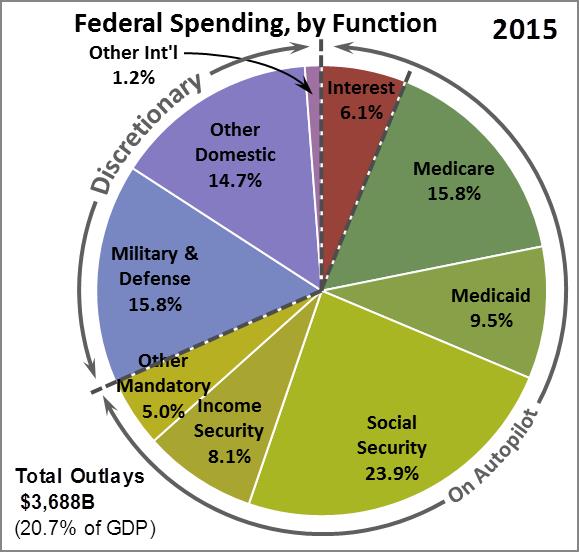
For further perspective, total US tax revenue in 2018 was 3.3 trillion dollars, with income taxes representing 51%, or 1.68 trillion. Income taxes will have to be raised by 984 billion, or 59%.

Are we willing to pay this in taxes?
In some ways, this is a foolish question. We are already paying it in employer and employee paid premiums, and in copays and deductibles. The only question is whether that money comes out as taxes to the feds or premiums to an insurer. Since insurers are actually less efficient with our money, it's better to pay it in taxes. We can presume that the money not going to health premiums will go to employees. Well, given employer behaviors we might need to make that a law. If, however, everyone saw an income increase of 8-19,000.00 yearly (let alone the 330 billion in out of pocket expense) then the increased tax burden looks rather different.
Average tax rates are quite different from marginal tax rates. While the uppermost income is taxed at 37%, all income under 500,000.00 is taxed at less, and the rate on 60,000.00, the average income for a family of 4 in the US, is 11.5%. Raising the tax rate on such a family to 19%, while they take home thousands in insurance premiums and copays not spent, is a net win, and would be just as much so for higher earners as well. There is, however, more that we can do.
So far we have considered how we will pay, but not who and what we will pay for. Broadly speaking, the US expects health insurers will pay for everything always. Excluded conditions, uncovered drugs, etc are all a source of outrage. This reaction ignores life and financial realities. If we turn healthcare over to the State then the State has a fiduciary interest to all citizens to use that money wisely. Society does not benefit from most elderly care, and certainly not from care of cancers, organ transplant or heart procedures in the elderly. Angry people call such exclusions 'death committees', but the social reality is most end-of-life care is futile.
We spend 88 billion yearly on nursing homes. See a previous blog (American Concentration Camps) for my view on these places. Besides that money, relatively few people and conditions account for a very high proportion of healthcare costs. While on the Blue Cross Provider Advisory Council I saw East Tennessee' drug use data. The most common prescriptions were for opiates- percocet and lorcet. Nearly 25% of all drug costs for East Tennessee, however, was accounted for by perhaps 100 scripts for a few drugs for about 20 patients. This is also true of hospitalization, where ICU costs are much higher than daily bed costs.
If the State limited coverage for end-of-life care, some procedures for the elderly, and ICU usage, total healthcare spending would drop roughly 20%. This shaves 700 billion from costs. Between administrative savings and care limitations, we have a system that is affordable.
So what do we do with the elderly? Do we let them die in the streets, or rot in pain at home? These are the images put forth by those advocating care for everything and everyone always, but it is far from the only option.
Looking to Canada and Britain for solutions is not reasonable, and shows what appears to be a bias in favor of English-speaking nations. Germany's solution is much better. There has been federal level German healthcare since 1871. There are limits on what is covered. The difference is paid via individual wrap-around policies. For those not familiar, a wrap-around is essentially personally purchased secondary insurance. I have a huge wrap-around policy for my home and family. Its total premium is a fraction of what I pay for home and auto insurance. The same is true for wrap-around health policies. They are inexpensive and can be tailored to personal choices and needs.
The issue of State control of healthcare is a hot button for many. They may not know to what extent care is already controlled, not by the government, but by insurance companies and other corporations. The rates for insurance, reimbursement for hospitals and doctors, what meds are covered, what procedures- all these things are being determined by a combination of a CMS committee and insurance companies. While I have little trust in the federal government I have even less trust in corporations, which operate for profit rather than national benefit. The orientation of health insurers become obvious when you know that the CEO of Blue Cross made 19.2 million dollars last year, and that many such companies are publicly traded, responsible to their shareholders for profit, not the consumer for wellbeing.
It has taken three weeks of reading and prep to write even this cursory look at healthcare financing, insurance and taxes. It is a complex issue. It is, however, entirely financially feasible to have full governmental healthcare. We are paying for it already, just not in taxes. 41% of Americans already get their healthcare from the federal government. The cost is not prohibitive, and would be either revenue neutral or a gain in net revenue for many families. The companies currently controlling the pattern of healthcare are corporations, many of them publicly traded for-profit companies and therefore with conflicts of interest between patient wellbeing and profit. Like so many issues, it is generating much heat and no light, and while politicians use the problem of the uninsured for personal gain, many Americans pay large amounts in premiums and copays to get care. A fully federal system, with wrap-arounds sold through private companies, would be cost-effective and comprehensive. It seems to me the right thing to do ethically, medically, and socially.
Ted
-Who will we cover?
-What will we cover?
-How are we paying for it?
As usual, political posturings on both sides are exaggerated and distort what is happening for individuals, healthcare providers, and consumers.
First, we must be able to answer the three questions now, without bias or rancor. At this time, 90-91% of all Americans have healthcare coverage of some kind. This is important for several reasons. First, the image of our nation having a healthcare coverage crisis is not accurate. Second, the ACA has indeed added roughly 4% of Americans to the total of the insured. While this is an admirable achievement, it has come at the cost of a great deal of bureaucracy and misunderstanding. Third, achieving the last 10% is much, much harder than achieving the first 90.
Our current system of coverage is variable in extent. Some plans cover virtually everything, while others cover only catastrophic hospitalizations. Primary care, about which so much ink and sanctimony have been spewed, is variably and incompletely covered, while emergencies and hospital procedures are surprisingly well covered, albeit often with high copays and deductibles.
How and what we are paying for is surprisingly easy to find from the Center for Medicare and Medicaid Services (CMS). The data is comrpehensive. Here is a CMS summary page. The tables and the summary page provide dense data on expenditures and sources of payment, and also what was paid for.
Total healthcare spending in the US wa the staggering total of 3.5 Trillion dollars last year, with federal programs paying 1.1 trillion of that and consumers paying 10%, or 350 billion, out of pocket.
Despite the hullaballoo about the uninsured they comprise only 7.5% of all Americans (legal residents). On the other hand, only 45% have employer-based coverage, the concept on which so many of our healthcare assumptions rest. 41% have federal insurance of one type or another- Medicare, Medicaid, CHIP, disability, federal workers. 4% have individual policies- the effect of the ACA.
Employer-based insurance also pays a lesser part of care than ever before. Private health insurance payments covered only 34% of healthcare in 2017. Medicare and Medicaid covered 37%. Out-of-pocket costs were 10% of all spending. This represents copays and deductibles, NOT insurance premiums (addressed below).
Since 1970 costs have shifted away from the consumer, but employer-based plans have higher deductibles and copays than in prior years. The result is employees pay 20% of their insurance premiums, and those with families pay 30%.. For families this is 5,700.00 per year on average, for single workers 1,241.00, per year. The Insurance information Institute found "Total private health insurance direct written premiums were $867.5 billion in 2017, including: $670.1 billion from the health insurance segment; $190.8 billion from the life/health segment; and $6.5 billion from property/casualty annual statements, according to S&P Global Market Intelligence." My own crude, assumptive calculation came out at 982 billion, so I was surprisingly close. I did not believe my answer until I found the III data.
Now, not all this 868 billion went to actual care. Administrative costs average 7%, and insurers have, typically, a built-in 'loss reserve' and profit of 20%. Actual care thus represents only 73% of 868 billion. That is still 634 billion dollars. Add to this the 350 billion in out of pocket costs. If we are to have full, federal-level healthcare, we must thus fund 984 billion dollars. To put this in perspective, here is a chart of all federal spending, discretionary and non-discretionary-
For further perspective, total US tax revenue in 2018 was 3.3 trillion dollars, with income taxes representing 51%, or 1.68 trillion. Income taxes will have to be raised by 984 billion, or 59%.
Are we willing to pay this in taxes?
In some ways, this is a foolish question. We are already paying it in employer and employee paid premiums, and in copays and deductibles. The only question is whether that money comes out as taxes to the feds or premiums to an insurer. Since insurers are actually less efficient with our money, it's better to pay it in taxes. We can presume that the money not going to health premiums will go to employees. Well, given employer behaviors we might need to make that a law. If, however, everyone saw an income increase of 8-19,000.00 yearly (let alone the 330 billion in out of pocket expense) then the increased tax burden looks rather different.
Average tax rates are quite different from marginal tax rates. While the uppermost income is taxed at 37%, all income under 500,000.00 is taxed at less, and the rate on 60,000.00, the average income for a family of 4 in the US, is 11.5%. Raising the tax rate on such a family to 19%, while they take home thousands in insurance premiums and copays not spent, is a net win, and would be just as much so for higher earners as well. There is, however, more that we can do.
So far we have considered how we will pay, but not who and what we will pay for. Broadly speaking, the US expects health insurers will pay for everything always. Excluded conditions, uncovered drugs, etc are all a source of outrage. This reaction ignores life and financial realities. If we turn healthcare over to the State then the State has a fiduciary interest to all citizens to use that money wisely. Society does not benefit from most elderly care, and certainly not from care of cancers, organ transplant or heart procedures in the elderly. Angry people call such exclusions 'death committees', but the social reality is most end-of-life care is futile.
We spend 88 billion yearly on nursing homes. See a previous blog (American Concentration Camps) for my view on these places. Besides that money, relatively few people and conditions account for a very high proportion of healthcare costs. While on the Blue Cross Provider Advisory Council I saw East Tennessee' drug use data. The most common prescriptions were for opiates- percocet and lorcet. Nearly 25% of all drug costs for East Tennessee, however, was accounted for by perhaps 100 scripts for a few drugs for about 20 patients. This is also true of hospitalization, where ICU costs are much higher than daily bed costs.
If the State limited coverage for end-of-life care, some procedures for the elderly, and ICU usage, total healthcare spending would drop roughly 20%. This shaves 700 billion from costs. Between administrative savings and care limitations, we have a system that is affordable.
So what do we do with the elderly? Do we let them die in the streets, or rot in pain at home? These are the images put forth by those advocating care for everything and everyone always, but it is far from the only option.
Looking to Canada and Britain for solutions is not reasonable, and shows what appears to be a bias in favor of English-speaking nations. Germany's solution is much better. There has been federal level German healthcare since 1871. There are limits on what is covered. The difference is paid via individual wrap-around policies. For those not familiar, a wrap-around is essentially personally purchased secondary insurance. I have a huge wrap-around policy for my home and family. Its total premium is a fraction of what I pay for home and auto insurance. The same is true for wrap-around health policies. They are inexpensive and can be tailored to personal choices and needs.
The issue of State control of healthcare is a hot button for many. They may not know to what extent care is already controlled, not by the government, but by insurance companies and other corporations. The rates for insurance, reimbursement for hospitals and doctors, what meds are covered, what procedures- all these things are being determined by a combination of a CMS committee and insurance companies. While I have little trust in the federal government I have even less trust in corporations, which operate for profit rather than national benefit. The orientation of health insurers become obvious when you know that the CEO of Blue Cross made 19.2 million dollars last year, and that many such companies are publicly traded, responsible to their shareholders for profit, not the consumer for wellbeing.
It has taken three weeks of reading and prep to write even this cursory look at healthcare financing, insurance and taxes. It is a complex issue. It is, however, entirely financially feasible to have full governmental healthcare. We are paying for it already, just not in taxes. 41% of Americans already get their healthcare from the federal government. The cost is not prohibitive, and would be either revenue neutral or a gain in net revenue for many families. The companies currently controlling the pattern of healthcare are corporations, many of them publicly traded for-profit companies and therefore with conflicts of interest between patient wellbeing and profit. Like so many issues, it is generating much heat and no light, and while politicians use the problem of the uninsured for personal gain, many Americans pay large amounts in premiums and copays to get care. A fully federal system, with wrap-arounds sold through private companies, would be cost-effective and comprehensive. It seems to me the right thing to do ethically, medically, and socially.
Ted
HI TED,
ReplyDeleteI AGREE WITH YOU THAT THE CENTRAL SYSTEM CONCEPT WOULD PROBABLY HELP OVER THIS PROFIT MULTIPLE PLAN AND PAYOUT LEVEL THAT IS BASICALLY MOVING TOWARD THE PATIENT PAYING MOSTLY OUT OF POCKET ANYWAY....
ALLEN CULPEPPER
Well researched, as usual, and helpful.
ReplyDeleteBesides the observations you make about coverage, for your readers, I would also add that contrary to the image presented by many news and media outlets, the poor in this country DO get treated. At present, most indigent care (that "final 10%" who are not insured) in the U.S. comes from hospitals and physicians who DONATE their services. Hospitals try to seek some compensation for this if they are in one of the states that participates in Medicaid reimbursement. The government provides compensation for low income patients via the DSH (Disproportionate Share Hospital), the government paying any qualified hospital serving a large number of Medicaid and uninsured patients. Non-profit hospitals also get tax breaks for taking care of the indigent. The problem is that research has shown that these compensations are not enough to offset hospital costs. How much discrepancy is there? Best estimates are that even after government compensation for taking care of the indigent, hospitals are absorbing 2/3 of the cost of uncompensated care. So hospitals basically function as the "insurers of last resort."
As for the doctors, they may charge the uninsured for services rendered, but a person who cannot afford insurance premiums is usually someone who will also not be able to pay a doctor's bill, which means that doctors are donating their services (while still paying the costs of running an office - rent, electricity, employees' salaries, supplies, etc.).
If the U.S. were to switch to a single-payer government format, I would hope that reform would also come in the area of copays and deductibles. It is frustrating to have fully insured patients who cancel exams and procedures because they cannot afford the copay (e.g., a patient who needs an MRI but cannot afford the $1,500 copay).
Finally, I agree completely that for-profit health corporations having priorities that are cross purposes with patient care. Their main goal is to make money. Period. Patient care is merely a means to an end. Jesus said, "you cannot serve God and mammon," and in the case of healthcare, this would become, "you cannot serve patients and profit." If we truly want universal healthcare in the U.S., for-profit insurers/medical corporations have to disappear.
(And this is besides the reforms needed in the pharmaceutical industry...)
-D-